
As rooftop solar adoption increases across Maharashtra, one term that homeowners frequently hear is net metering. Many people are interested in installing solar panels but want to clearly understand how net metering works, the benefits it offers, and what rules apply in Maharashtra.
At Desai Techno Solutions, we regularly guide customers through rooftop solar installations and net metering approvals. In this blog, we explain net metering in Maharashtra clearly and practically, covering benefits, process, eligibility, and rules, so you can make an informed decision before going solar.
What Is Net Metering?
Net metering is a billing system for grid-connected rooftop solar systems. When your solar panels generate more electricity than you consume, the excess power is exported to the electricity grid. This exported energy is recorded by a net meter, and you receive unit credits in your electricity bill.
At night or during low solar generation, you can use electricity from the grid, and the credited units are adjusted against your consumption.
In simple terms, net metering allows you to:
- Use solar power during the day
- Export surplus electricity
- Reduce your electricity bills
How Net Metering Works in Maharashtra
Understanding how net metering works in Maharashtra helps users feel confident about the rooftop solar investment.
Here’s a simplified explanation:
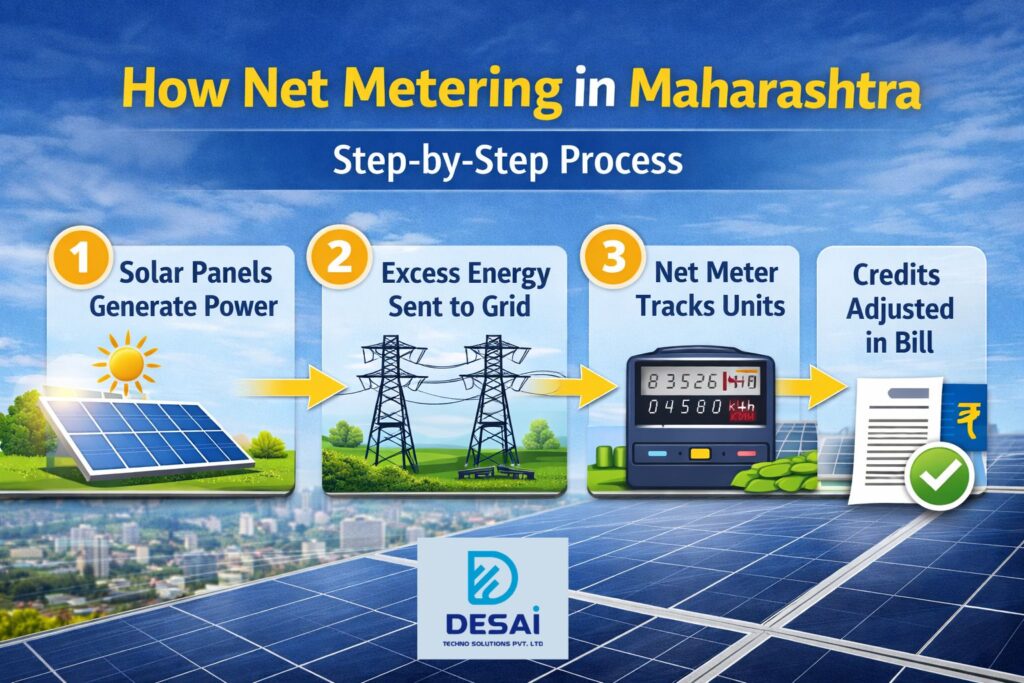
- Solar panels generate electricity during daylight hours
- Power is first used for your home or business
- Extra power flows to the grid
- The net meter records the exported and imported units
- Monthly bills reflect the net consumption
This system ensures maximum savings and better utilisation of your rooftop solar system.
Benefits of Net Metering for Rooftop Solar Users
1. Lower Electricity Bills
The biggest advantage of rooftop solar net metering is reduced power bills. Exported units directly offset grid consumption.
2. Better Return on Investment
Net metering improves the payback period of rooftop solar, usually helping users recover costs within 3–5 years.
3. No Power Wastage
Excess solar energy is not wasted—it is supplied to the grid.
4. Simple Billing System
Electricity bills clearly show imported, exported, and net units.
5. Environment-Friendly Solution
Using rooftop solar energy reduces dependence on fossil fuels and lowers carbon emissions.
Net Metering Eligibility in Maharashtra
Before applying, users must meet certain eligibility conditions:
- Grid-connected rooftop solar system
- Valid electricity connection
- Installation done by a registered solar company
- Compliance with DISCOM technical guidelines
- Available rooftop space
At Desai Techno Solutions, we first assess site feasibility to ensure smooth net metering approval.
Net Metering Process in Maharashtra (Step-by-Step)
Many users search for the net metering process in Maharashtra because the procedure often seems complicated. Here’s a simplified breakdown:
Step 1: Online Application
Apply for rooftop solar and net metering through the DISCOM or official rooftop solar portal.
Step 2: Vendor Selection
Choose an experienced and registered solar installation expert like Desai Techno Solutions.
Step 3: Technical Approval
DISCOM reviews system capacity, load details, and documents.
Step 4: Rooftop Solar Installation
Solar panels, the inverter, and the structure are installed as per the approved design.
Step 5: Net Meter Installation
After inspection, the DISCOM installs a bi-directional net meter.
Step 6: System Commissioning
Once commissioned, your system starts exporting electricity to the grid.
Net Meter Installation Process & Timeline
The net meter installation process generally takes:
- 7–15 days after solar installation
- Depends on DISCOM workload and documentation accuracy
Working with the best rooftop solar company in Maharashtra, like Desai Techno Solutions, helps avoid unnecessary delays.b
Maharashtra Net Metering Rules & Regulations
Net metering in Maharashtra is governed by MERC (Maharashtra Electricity Regulatory Commission) guidelines.
Key MERC Net Metering Rules:
- Applicable for residential, industrial & commercial solar users
- Capacity limited to sanctioned load (varies by DISCOM)
- Annual settlement of unused credits
- Grid safety and technical standards must be followed
These Maharashtra net metering rules are designed to balance consumer benefits with grid stability.
Net Metering Tariff Credits & Billing System
Users often ask about net metering tariff credits.
- Exported units are adjusted against imported units
- Excess credits may be settled annually
- Billing cycles depend on DISCOM policy
This transparent system helps users track their rooftop solar savings effectively.
Net Metering vs Net Billing: What’s the Difference?
A common user query is net billing vs net metering.
| Feature | Net Metering | Net Billing |
|---|---|---|
| Unit Adjustment | One-to-on | Different rates |
| Savings | Higher | Moderate |
| Complexity | Simple | Slightly complex |
| Ideal for | Residential solar | Large systems |
For most homes in Maharashtra, net metering is the better option.
Rooftop Solar Savings in Maharashtra
With net metering, users can save:
- Up to 90% on electricity bills
- Protection from tariff hikes
- Long-term financial stability
While industrial and commercial solar users get significant operational cost reductions, residential solar users get the highest returns
Group & Virtual Net Metering
Some DISCOMs allow:
- Group net metering for housing societies
- Virtual net metering for shared ownership setups
These options help apartment residents participate in rooftop solar even with limited space.
Why Choose Desai Techno Solutions for Net Metering?
At Desai Techno Solutions, we provide complete rooftop solar systems and net metering support:
- Site feasibility assessment
- System design & installation
- Net metering documentation
- DISCOM coordination
- Post-installation support
Our expert team ensures compliance with MERC guidelines and smooth approval timelines.
Common User Questions Answered
- Is net metering mandatory for rooftop solar? Yes, for grid-connected systems, net metering is essential.
- Can I install solar without net metering? Yes, but you won’t get export benefits.
- Are commercial and industrial solar systems permitted to use net meters? Yes, subject to DISCOM capacity limits.
- Does net metering reduce solar system cost? Indirectly yes, by increasing savings and ROI.
Conclusion
Net metering in Maharashtra plays a crucial role in making rooftop solar affordable, practical, and efficient. By understanding its benefits, process, and regulations, users can confidently move toward clean energy.
Net metering guarantees that you get the most out of your investment, whether you’re planning a home rooftop solar system, an industrial and commercial solar system, or future solar expansion.
By choosing an experienced and registered solar company like Desai Techno Solutions, you get expert guidance, hassle-free approvals, and long-term peace of mind.
Planning a rooftop solar installation?
Connect with Desai Techno Solutions today and take the first step toward smart energy savings